AWS S3 Object Backup and Delayed Cleanup System
Overview
This project is an event-driven AWS backup system that listens to S3 object create and delete events, creates timestamped backup copies in a destination bucket, tracks every copy in DynamoDB, and removes stale backup copies through a scheduled cleanup workflow.
It is a compact serverless design, but it covers several production-style concerns at once:
- event-driven replication
- metadata-driven lifecycle management
- delayed cleanup instead of immediate destructive deletes
- DynamoDB access patterns designed around
Query, notScan - CDK stack boundaries chosen to avoid circular dependencies
Summary
I built this project to show that backup logic is not just "copy a file somewhere else." The harder part is controlling the lifecycle of those copies after the source object changes or disappears.
The system uses one source bucket, one destination bucket, one metadata table, one event-driven replication path, and one scheduled cleanup path:
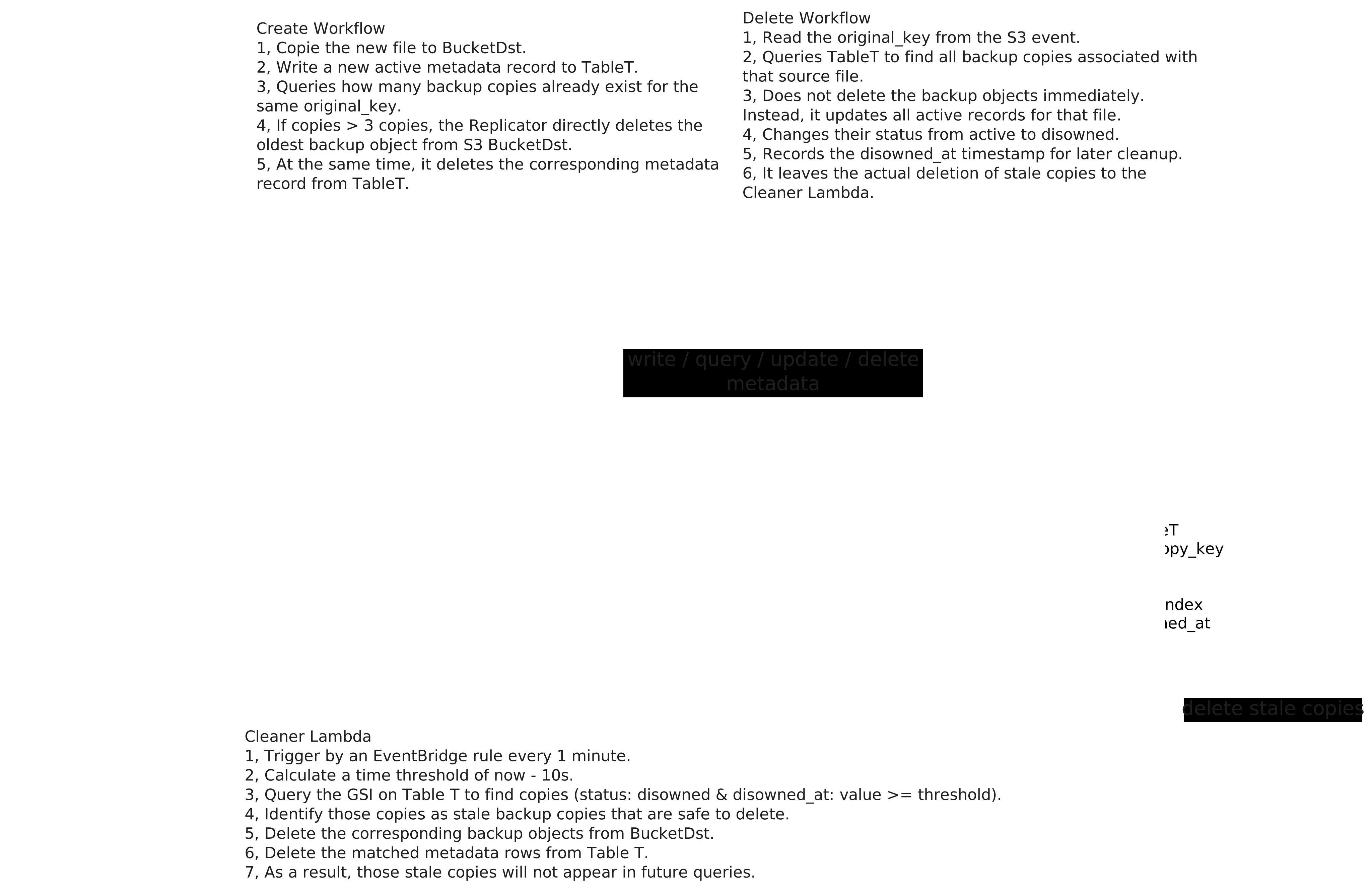
BucketSrcreceives the original object eventsReplicator Lambdacreates backup copies inBucketDstTableTrecords which backup copies belong to which original objectCleaner Lambdaperiodically deletes copies that were marked as disowned long enough ago to be safe to remove
What makes this useful in an interview is that it shows more than service familiarity. It shows that I understand:
- how to model object lifecycle state explicitly
- why delayed deletion can be safer than immediate deletion
- how to design a DynamoDB schema for concrete query patterns
- how to use EventBridge for periodic remediation work
- how CDK stack boundaries can create or avoid deployment cycles
Tech Stack
Python, AWS CDK, Lambda, S3, DynamoDB, EventBridge
Architecture
The architecture is centered around two workflows: create and delete.
High-level flow
- A user uploads or deletes an object in
BucketSrc S3sends a create or delete event toReplicator Lambda- On create:
- the object is copied into
BucketDstusing a timestampedcopy_key - a new
activemetadata row is written intoTableT - the system checks how many copies already exist for the same
original_key - if there are more than
3, the oldest backup copy is deleted immediately
- the object is copied into
- On delete:
Replicator LambdaqueriesTableTfor all copies of that original object- it does not delete the copies immediately
- instead it changes their status from
activetodisowned - it records
disowned_atfor later cleanup
Cleaner Lambdaruns every minute from anEventBridgeschedule- The cleaner queries the
status-disowned_at-indexGSI for disowned copies older than10seconds - For each matching row, it deletes the backup object from
BucketDstand removes the metadata row fromTableT
Why This Design
Why copy on create
Create handling is straightforward: a source object still exists, so the system can perform a server-side copy into the destination bucket and immediately register that copy in metadata.
The timestamp suffix in the copy_key solves two problems at once:
- every backup copy is unique
- copies are sortable by age, which makes "delete the oldest copy" easy
Why mark copies as disowned on delete
The delete path is intentionally different.
When the original file is deleted, the system does not immediately delete all backup copies. Instead, it marks them as disowned and lets the scheduled cleaner remove them later.
That choice matters because it creates a clear lifecycle boundary:
- replication handles source-of-truth changes
- cleanup handles garbage collection
This is a useful systems pattern because it reduces the amount of destructive work done directly inside the event-triggered path.
Why DynamoDB
The backup bucket alone is not enough because S3 stores objects, not relationships.
The system needs metadata that answers questions like:
- which backup copies belong to this original file
- how many copies of this object exist right now
- which copy is the oldest
- which copies are disowned and old enough to delete
DynamoDB fits well here because the system has a small set of very clear key-based access patterns.
Why split into three stacks
The code is split into:
StorageStackReplicatorStackCleanerStack
The important design choice is that BucketSrc lives inside ReplicatorStack, not StorageStack.
That avoids a CDK circular dependency:
- the replicator needs bucket information to configure the Lambda environment
- the source bucket notification needs the Lambda ARN
Putting BucketSrc and Replicator Lambda in the same stack removes that deployment cycle.
Data Model
The project uses one table, TableT.
Primary key design
The table stores one row per backup copy:
| Attribute | Meaning |
|---|---|
original_key | original object name in BucketSrc |
copy_key | timestamped backup object name in BucketDst |
created_at | creation time in Unix milliseconds |
status | active or disowned |
disowned_at | time when the copy became disowned |
Primary key shape:
- partition key:
original_key - sort key:
copy_key
This makes the main replication queries simple:
- query all copies for one original object
- count how many copies already exist
- find the oldest copy
GSI design
The table also defines:
- GSI name:
status-disowned_at-index - partition key:
status - sort key:
disowned_at
This index exists for one reason: the cleaner must find stale disowned copies without doing a full table scan.
That is the key interview point in this design. The GSI is not "extra metadata." It directly encodes the cleaner's access pattern.
Lambda Responsibilities
Replicator Lambda
This Lambda handles both ObjectCreated and ObjectRemoved events from BucketSrc.
For create events, it:
- builds a timestamped
copy_key - copies the object from
BucketSrctoBucketDst - writes a new
activerow intoTableT - queries existing copies for the same
original_key - deletes the oldest copy if the count exceeds
3
For delete events, it:
- queries all rows for the deleted
original_key - marks active copies as
disowned - records a shared
disowned_attimestamp
Cleaner Lambda
This Lambda is triggered by EventBridge every minute.
It:
- computes a threshold of
now - 10 seconds - queries the GSI for disowned rows older than that threshold
- deletes the corresponding objects from
BucketDst - deletes the matching rows from
TableT
This makes the cleanup path predictable and keeps the event-driven path focused on state transitions.
Runtime Behavior
The expected behavior looks like this:
- Upload
Assignment1.txt- one backup copy is created
- one
activerow is written
- Re-upload the same object multiple times
- each upload creates a new timestamped copy
- once the count exceeds
3, the oldest copy is deleted
- Delete the source object
- backup copies are not immediately removed
- their rows are marked
disowned
- Wait for the cleaner schedule
- the cleaner finds disowned copies older than the threshold
- those copies and rows are permanently deleted
That behavior demonstrates two separate retention rules:
- keep at most
3backup copies for still-owned objects - remove stale copies only after they become disowned and old enough
Tradeoffs and Practical Lessons
The main tradeoff in this project is between simplicity and lifecycle control.
An immediate-delete design would be simpler, but it would mix replication and cleanup into one Lambda path. This implementation deliberately separates them, which makes the object lifecycle easier to explain and reason about.
The other key lesson is schema-driven design:
- the primary key exists for the replicator's query path
- the GSI exists for the cleaner's query path
That is a better DynamoDB story than storing generic metadata first and trying to recover the access pattern later.
Project Bullet Point
- Built an event-driven AWS serverless backup system that replicated S3 objects into a destination bucket, enforced a three-copy retention rule, and removed stale copies through a scheduled delayed-cleanup workflow.
- Designed a
DynamoDBschema withoriginal_key/copy_keyas the primary key and astatus-disowned_at-indexGSI so both replication and cleanup paths could useQueryinstead ofScan. - Implemented the infrastructure in
AWS CDK, splitting storage, replication, and cleanup into separate stacks while avoiding the circular dependency created by S3 event notifications.
Interview Takeaways
This project is useful for discussing:
- how to model backup object lifecycle state
- why delayed cleanup can be safer than immediate deletion
- how to design DynamoDB tables from access patterns
- why scheduled remediation is a good fit for EventBridge
- how cross-stack AWS references can create CDK deployment cycles
Good questions to be ready for:
- Q: Why not delete backup copies immediately when the source file is deleted?
A: Separating delete marking from physical cleanup keeps the event path simpler and makes cleanup behavior easier to reason about and schedule. - Q: Why use a GSI instead of scanning for disowned copies?
A: The cleaner has a precise query pattern, so the index makes cleanup proportional to matching rows instead of total table size. - Q: Why timestamp the
copy_key?
A: It guarantees uniqueness and makes oldest-copy selection straightforward. - Q: Why does
BucketSrclive with the replicator stack?
A: S3 notifications need the Lambda ARN, and the Lambda needs bucket configuration, so separating them the wrong way creates a circular dependency.